summon.guideAll guides

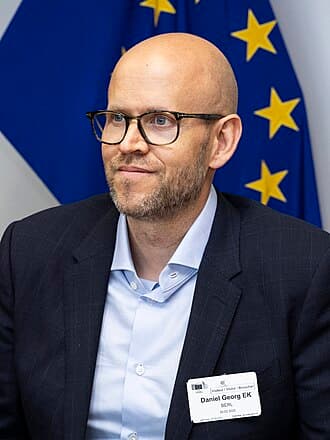
Daniel Ek

Swedish entrepreneur and technologist; co-founder of Spotify, its chief executive from 2006 to 2025 and its executive chairman since 2026.

1983–present · Stockholm, Sweden

Install Daniel's frameworks in Claude Code

/plugin marketplace add adamtpang/summon.guide
/plugin install daniel-ek

Installs 1 skill from Daniel, plus the rest of summon.guide. Source on GitHub.

Early life and education

Daniel Georg Ek was born on 21 February 1983 in Stockholm and grew up in Rågsved, a working class housing estate on the southern edge of the city. His biological father was not part of his childhood; he was raised by his mother, alongside a stepfather and a younger brother, in a household he has described as ordinary Swedish and short of money. Music was the constant. In the founder letter he wrote for Spotify's 2018 prospectus he put it plainly: from the age of four his life was about music and technology, never one without the other. He learned guitar as a small child and was good enough as a singer and player that his school music teacher remembered him. The technology half turned into income early. From about fourteen he was building websites, first for schoolmates and then for businesses, and running a small web hosting operation out of his bedroom, making real money before he had any concept of what a company was. He graduated from IT-Gymnasiet in Sundbyberg in 2002, enrolled in engineering at the KTH Royal Institute of Technology, and left after roughly eight weeks. What followed was a compressed apprenticeship across the early Swedish internet: the search marketing firm Jajja, a senior role at the Nordic auction site Tradera, which eBay acquired in 2006, and the job of chief technology officer at the browser based fashion community Stardoll. He then founded Advertigo, an online advertising company that TradeDoubler acquired in March 2006, and briefly served as chief executive of the file sharing client µTorrent, working with its creator Ludvig Strigeus until BitTorrent bought it in December 2006. Strigeus later joined him as a Spotify engineer. The Advertigo sale and the work behind it left Ek rich enough in his early twenties to retire, and for a few months he did, before concluding that retirement at that age was empty and that what he actually wanted was a problem worth a decade.

Career

Ek had been circling the same problem since about 2002, when Napster was shut down and Kazaa took its place. His conclusion was that piracy could not be legislated away, and that the only workable answer was a legal service that was simply better than stealing while still paying the industry. In 2006 he incorporated Spotify AB in Stockholm with Martin Lorentzon, the TradeDoubler co-founder he had met through the Advertigo sale, and spent two years negotiating licences with rights holders who had every reason to distrust him. The service launched on 7 October 2008, invitation only, in Sweden, Finland, Norway, France, the United Kingdom and Spain, and reached the United States in July 2011. Early versions used a peer to peer architecture borrowed from the file sharing world, which Spotify replaced with a server client model in 2014. Ek spent years defending the free, ad supported tier against label executives who wanted everything behind a paywall, arguing that free was how you reached scale and scale was how you produced subscribers. In October 2016 Lorentzon stepped down as chairman of the board and Ek took that role alongside the chief executive job. Spotify Technology S.A., incorporated in Luxembourg, filed its Form F-1 with the United States Securities and Exchange Commission on 28 February 2018, a 256 page document that carried an unusually personal founder letter at its centre, and listed on the New York Stock Exchange under the ticker SPOT on 3 April 2018. It was a direct listing rather than an underwritten initial public offering: no bank underwrote the deal, the company issued no new shares and raised no money, and there was no offering price, only a reference price of $132 set by the exchange. The stock opened at $165.90, touched $169 and closed its first day at $149.01. Ek and Lorentzon retained control through beneficiary certificates that carry votes but no economic rights. In the years after, Ek pushed the company beyond music into podcasts, buying Gimlet Media and Anchor in 2019 and signing Joe Rogan to an exclusive deal in 2020, and later into audiobooks. The expansion was expensive, and in December 2023 he cut roughly 1,500 jobs, about 17 percent of the company, in the third round of layoffs that year, later conceding that the cuts disrupted day to day operations more than he had anticipated. The discipline showed up in the accounts: 2024 was, in his own words, the first full year of profitability in the company's history. As of the first quarter of 2026, reported on 28 April 2026, Spotify had 761 million monthly active users and 293 million Premium subscribers. On 30 September 2025 Ek announced that he would give up the chief executive job. From 1 January 2026 he became executive chairman, with co-presidents Gustav Söderström and Alex Norström promoted to co-chief executives, both still reporting to him. He described the arrangement as a European chairman setup rather than an American one, more hands on than the title usually implies, with his own time going to long term strategy, capital allocation, regulatory work and the decisions that shape the next decade. Outside Spotify he co-founded the preventive health company Neko Health with the engineer Hjalmar Nilsonne in 2018, seeding it himself with about 30 million euros and chairing it without running it; in July 2026 Neko raised a $700 million Series C at a valuation approaching $7 billion. In February 2021 he set up the investment company Prima Materia with Shakil Khan, pledging $1 billion to European moonshots, and through it became an early backer and then chairman of the German defence technology company Helsing, leading a 600 million euro round in it in June 2025. A lifelong Arsenal supporter, he made an offer of roughly 1.8 billion pounds for the club in May 2021, which its owners rejected.

Legacy and death

Ek's central achievement is that he beat piracy by out-building it rather than by suing it. Global recorded music revenue had been shrinking for most of a decade when Spotify launched, and streaming, which Spotify did more than any other company to normalise, became the industry's main revenue engine and returned it to growth. Spotify's Loud & Clear 2026 report put payouts to the music industry at about $11 billion for 2025 and roughly $70 billion in total, with independent artists and labels generating about half of all royalties on the platform. His 2018 direct listing was equally consequential in a narrower world: by proving a large company could go public with no underwriters, no new shares and no offering price, it created the template later used by Slack, Palantir, Coinbase and others. He is also the most visible argument that a global technology company can be built outside Silicon Valley, and he has spent his post-CEO capital deliberately on European bets in health and defence. He remains one of the most contested figures in music. Artists and producers have attacked Spotify's per stream economics for over a decade, and Ek personally after a 2020 interview in which he said artists could no longer record once every three or four years and expect that to be enough, and again after a 2024 post in which he described the cost of creating content as close to zero, a phrasing he later admitted was clumsy and reductive. Liz Pelly's book Mood Machine (2025) became the standard critical account of what playlist driven streaming did to musicians. Prima Materia's investment in Helsing opened a second front: bands including Deerhoof, Xiu Xiu, King Gizzard and the Lizard Wizard, Godspeed You! Black Emperor, Sylvan Esso and Massive Attack pulled catalogue from Spotify in protest at their streams helping fund military AI. Spotify's answer to the transparency complaint has been the annual Loud & Clear royalty reports, first published in 2021, which put the payout data in public. The tension is unresolved, and it is the shape of his legacy: he made music universally available and durably profitable as an industry, while the question of who inside that industry gets paid remains an argument he has not won.

Claude Code skills

Frameworks distilled from Daniel’s life, packaged as Claude Code skills. Each skill is invoked with a slash command and grounded in the primary biographies listed under References.

Install in Claude Code

/plugin marketplace add adamtpang/summon.guide
/plugin install daniel-ek

Bring Daniel’s frameworks into your terminal. One install registers every guide’s skills.

Notable quotes

Happiness is a trailing indicator of impact.
Music was too important to me to let piracy take down the industry.
We start with human creativity, augment it with our expertise and understanding, and then leverage with the efficiency of algorithms.
We really do believe that we can improve the world, one song at a time.
I have always thought about roles as missions. At Spotify, I have had about nine missions while keeping the same title.
I think happiness is a trailing indicator of impact.
Advice is useless unless it's tied to who you are as a person.

References

Their voice on summon.guide is grounded in:

  • Spotify Technology S.A., Form F-1 registration statement filed with the U.S. Securities and Exchange Commission on 28 February 2018, including the founder letter on pages 92 to 93 headed "Our Path: A Note from Daniel Ek, Co-Founder, Chief Executive Officer, and Chairman" (https://www.sec.gov/Archives/edgar/data/1639920/000119312518063434/d494294df1.htm)
  • Daniel Ek, "Evolving How We Lead", note to all Spotify employees, Spotify Newsroom, 30 September 2025 (https://newsroom.spotify.com/2025-09-30/daniel-ek-letter-evolving-how-we-lead/), published alongside the company press release announcing his move to executive chairman
  • Spotify Technology S.A., "Spotify Reports First Quarter 2026 Earnings", 28 April 2026 (https://newsroom.spotify.com/2026-04-28/spotify-q1-2026-earnings/), the source for all user and subscriber figures cited here
  • Spotify, Loud & Clear 2026 royalty transparency report (https://loudandclear.byspotify.com/), the source for 2025 and lifetime payout figures
  • Daniel Ek in conversation with David Senra, published 28 September 2025, the long form interview that is the source for his remarks on impact, self-knowledge and advice
  • Daniel Ek, Wikipedia (https://en.wikipedia.org/wiki/Daniel_Ek), used for dates, education, early employers and personal life

Further reading: en.wikipedia.org/wiki/Daniel_Ek

Other guides