summon.guideAll guides

David Deutsch

Physicist, pioneer of quantum computation, philosopher.

1953–present · Oxford, England

Install David's frameworks in Claude Code

/plugin marketplace add adamtpang/summon.guide
/plugin install deutsch

Installs 15 skills from David, plus the rest of summon.guide. Source on GitHub.
Early life and education

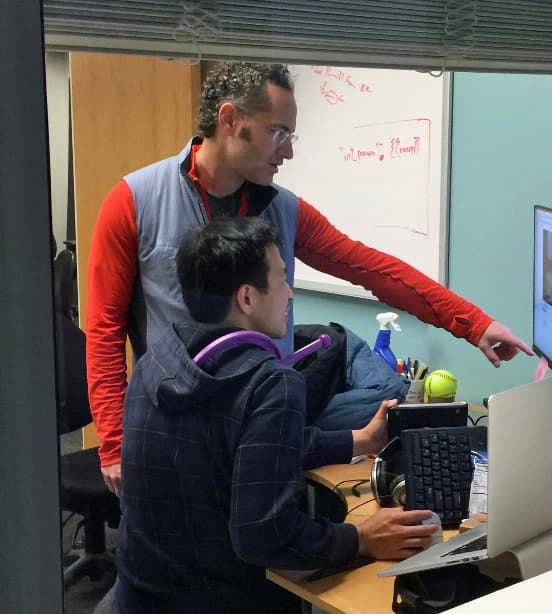
Deutsch was born in Haifa, Israel, on May 18, 1953, to Holocaust survivors Oskar and Tikva Deutsch. The family later moved to London. He read natural sciences at Clare College, Cambridge, and completed his doctorate at Wolfson College, Oxford in 1978 under Dennis Sciama, with a thesis on quantum field theory in curved space-time. He has remained at Oxford ever since, holding a position at the Centre for Quantum Computation at the Clarendon Laboratory.

Career

In 1985 Deutsch published “Quantum theory, the Church-Turing principle and the universal quantum computer”, the foundational paper that defined the quantum Turing machine and effectively founded the field of quantum computation. With Richard Jozsa he produced the Deutsch–Jozsa algorithm in 1992, one of the first quantum algorithms exponentially faster than any classical counterpart. His first book, The Fabric of Reality (1997), argued that four strands, quantum physics (the multiverse), epistemology (Popper's conjecture-and-criticism), evolution (Darwin), and computation (Turing), are deeply intertwined. His second book, The Beginning of Infinity (2011), argues that good explanations, ones that are hard to vary while still accounting for what they explain, are the engine of unbounded human progress. In 2012, with Chiara Marletto, he proposed constructor theory, an attempt to reformulate physics in terms of which transformations are possible and which are not.

Legacy and death

Deutsch is a Fellow of the Royal Society, won the Isaac Newton Medal in 2017, and shared the 2022 Breakthrough Prize in Fundamental Physics for foundational work on quantum information. The Beginning of Infinity has become a touchstone text for a generation of technologists and entrepreneurs as a defense of definite optimism: the view that all problems are soluble unless forbidden by the laws of physics, and that pessimism is bad epistemology, not realism.

Claude Code skills

Frameworks distilled from David’s life, packaged as Claude Code skills. Each skill is invoked with a slash command and grounded in the primary biographies listed under References.

Channel Deutsch

/deutsch:deutsch

Examine the question's hidden assumptions. Test explanations by trying to vary them. Reject 'just so' stories. Apply the Principle of Optimism.

Source: The Beginning of Infinity by David Deutsch

Hard-to-Vary Explanations

/deutsch:good-explanations

A good explanation is hard to vary while still accounting for what it explains. Test every detail by trying to swap it.

Source: The Beginning of Infinity by David Deutsch, Chapter 1 (the seasons example: Persephone vs axial tilt)

The Principle of Optimism

/deutsch:principle-of-optimism

All evils are caused by insufficient knowledge. All problems are soluble unless forbidden by physics.

Source: The Beginning of Infinity by David Deutsch, Chapter 9 (Optimism)

The Four Strands

/deutsch:four-strands

Quantum physics, epistemology, evolution, and computation are one theory, not four.

Source: The Fabric of Reality by David Deutsch, Chapter 1

The Problem-Solving Cycle

/deutsch:problem-solving-cycle

A problem is not solved by piling up data, it is solved by conjecturing rival explanations and letting criticism eliminate the weak ones.

Source: The Fabric of Reality by David Deutsch, Chapter 3 (Problem-solving)

The Kicked Rock Test

/deutsch:kicked-rock-test

Treat something as real when denying it costs more complexity than accepting it, and refute a doctrine by following it all the way to its own conclusion.

Source: The Fabric of Reality by David Deutsch, Chapter 4 (Criteria for Reality)

Build the Universal Version

/deutsch:universal-version

A rule built for the whole class of a situation keeps working on cases you have not met yet. A rule built for one case has to be rebuilt every time.

Source: The Fabric of Reality by David Deutsch, Chapter 6 (Universality and the Limits of Computation)

The Certainty Audit

/deutsch:certainty-audit

A proof is a physical process resting on an assumption, not a separate category of truth above ordinary explanation.

Source: The Fabric of Reality by David Deutsch, Chapter 10 (The Nature of Mathematics)

The Seminar Room Rule

/deutsch:seminar-room-rule

In a real critical tradition rank is not an allowed rebuttal, and everyone present knows exactly when that rule is and is not in effect.

Source: The Fabric of Reality by David Deutsch, Chapter 13 (The Four Strands), the critique of Kuhn's paradigms

The Jump to Universality

/deutsch:jump-to-universality

A narrow tool built for specific cases can gain unlimited reach through one small rule change. Look for the arbitrary limit you can remove.

Source: The Beginning of Infinity by David Deutsch, Chapter 6, The Jump to Universality (the alphabet, positional numerals, Babbage's Analytical Engine, the genetic code)

Who The Replicator Actually Serves

/deutsch:replicator-interest

Selection favors whatever spreads best, not whatever is good for you. Ask who benefits before you keep feeding it.

Source: The Beginning of Infinity by David Deutsch, Chapter 4, Creation (the neo-Darwinian selection argument, extended from genes to memes)

Spotting Bad Philosophy

/deutsch:spot-bad-philosophy

Bad philosophy is not just wrong, it is built to make the next question illegitimate. Test any claim by asking what happens when you keep asking why.

Source: The Beginning of Infinity by David Deutsch, Chapter 12, A Physicist's History of Bad Philosophy (the Copenhagen interpretation, logical positivism)

A Choice Is An Explanation, Not A Weighing

/deutsch:choice-as-explanation

When every option on the table looks bad, that is a sign your explanation is missing, not a signal to compute harder among bad options.

Source: The Beginning of Infinity by David Deutsch, Chapter 13, Choices (the critique of social choice theory and Arrow's impossibility theorem, extended to personal decisions)

Rational Versus Anti-Rational Memes

/deutsch:rational-vs-anti-rational-memes

A belief that survives scrutiny is a rational meme. A belief that survives by disabling scrutiny is an anti-rational one. Test which kind you are holding.

Source: The Beginning of Infinity by David Deutsch, Chapter 15, The Evolution of Culture (rational memes, anti-rational memes, static society thinking)

Build Problem-Solving Capacity, Not A Sustainable Steady State

/deutsch:unsustainable-by-design

Every closed, fixed plan meets an unforeseen problem eventually. Judge a plan by how well it can create new solutions, not by whether it claims to need none.

Source: The Beginning of Infinity by David Deutsch, Chapter 17, Unsustainable (Easter Island's static culture, the falsified Ehrlich resource-collapse predictions)

Install in Claude Code

/plugin marketplace add adamtpang/summon.guide
/plugin install deutsch

Bring David’s frameworks into your terminal. One install registers every guide’s skills.

Books

Each Claude Code skill above is grounded in a specific passage of a specific book. These are the primary sources we drew from for David.

Notable quotes

Problems are inevitable. Problems are soluble.
Optimism is, in the first instance, a way of explaining failure, not prophesying success.
All evils are caused by insufficient knowledge.
The universe is not there to overwhelm us; it is our home, and our resource. The bigger the better.
An unproblematic state is a state without creative thought. Its other name is death.
Experience is essential to science, but its role is different from that supposed by empiricism. It is not the source from which theories are derived.

References

Their voice on summon.guide is grounded in:

  • The Beginning of Infinity by David Deutsch (2011)
  • The Fabric of Reality by David Deutsch (1997)

Further reading: en.wikipedia.org/wiki/David_Deutsch

Other guides