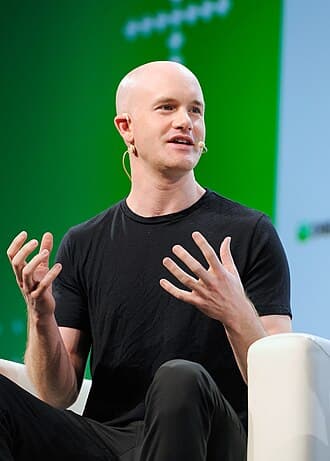
Career
In May 2011 Armstrong joined Airbnb as a software engineer, where he saw payments running through the roughly 190 countries the company then served, including how expensive it was to get money into South America. He wrote code on nights and weekends, in Ruby and JavaScript, to buy and store cryptocurrency, and in May 2012 he posted on Hacker News looking for a co-founder so he could apply to Y Combinator. He was accepted into the summer 2012 batch with a $150,000 investment and left Airbnb in June 2012. Coinbase's SEC filings date the company's inception to May 2012, and it is commonly dated to June 2012, when it launched publicly. Armstrong met Fred Ehrsam, a former Goldman Sachs foreign exchange trader, through a Reddit community, and Ehrsam joined as co-founder. Union Square Ventures led a roughly $5 million Series A in May 2013, Andreessen Horowitz led a $25 million Series B that December with Union Square Ventures and Ribbit Capital participating, and a 2018 round valued Coinbase at $8.1 billion.
On September 27, 2020, Armstrong published a post titled 'Coinbase is a mission focused company', stating that the company would not take positions on broader social and political questions unrelated to its mission, and offering a severance package to any employee who preferred to leave over it. About 60 employees, roughly 5 percent of the company, took it. Coinbase filed its Form S-1 publicly on February 25, 2021, and its Class A shares began trading on the Nasdaq Global Select Market under the ticker COIN on April 14, 2021 through a direct listing rather than an underwritten offering. Nasdaq set a reference price of $250, the stock traded as high as about $429, and it closed its first day at $328.28, a valuation reported at roughly $85 billion. Armstrong has been chairman of the board since February 2021, and because he controls a majority of the voting power, Coinbase qualifies as a controlled company under Nasdaq rules. Outside Coinbase he founded the open science platform ResearchHub in January 2020 and co-founded NewLimit, an epigenetic reprogramming company, with the investor Blake Byers in December 2021. He launched the nonprofit GiveCrypto.org in 2018, which wound down in 2023, and signed the Giving Pledge in 2018, though Bloomberg reported in July 2024 that he was no longer listed as a signatory.
Coinbase's regulatory record runs on two separate tracks that are frequently collapsed into one. On the rulemaking track, the company petitioned the U.S. Securities and Exchange Commission in July 2022 to write rules clarifying how the federal securities laws apply to digital assets; the SEC denied that petition in December 2023; Coinbase challenged the denial; and on January 13, 2025 the U.S. Court of Appeals for the Third Circuit, in Coinbase, Inc. v. SEC, held the denial conclusory and insufficiently reasoned, and therefore arbitrary and capricious, remanding it to the agency for a reasoned explanation. The court did not order the SEC to write rules. On the separate enforcement track, the SEC issued Coinbase a Wells notice on March 22, 2023 and filed a civil enforcement action on June 6, 2023 in the Southern District of New York, alleging that Coinbase operated as an unregistered exchange, broker, and clearing agency; Coinbase contested the claims. More than six weeks after the appellate ruling, on February 27, 2025, the SEC announced it had agreed to dismiss that enforcement action, and the parties stipulated to dismissal with prejudice, with no penalty paid and no changes required to the business. Coinbase joined the S&P 500 on May 19, 2025, replacing Discover Financial Services and becoming the first crypto-native company in the index. In the surrounding period the company also became one of the largest corporate donors to Fairshake, a crypto industry super political action committee, contributing more than $75 million across the 2024 cycle and its affiliated committees.