summon.guideAll guides

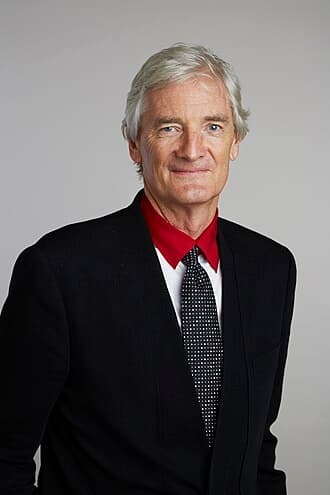
James Dyson

Inventor, industrial designer and engineer; founder and chairman of Dyson, and the creator of the dual cyclone bagless vacuum cleaner.

1947–present · Malmesbury, Wiltshire, England

Install James's frameworks in Claude Code

/plugin marketplace add adamtpang/summon.guide
/plugin install james-dyson

Installs 1 skill from James, plus the rest of summon.guide. Source on GitHub.

Early life and education

James Dyson was born on 2 May 1947 in Cromer, Norfolk, the youngest of three children. Both his parents taught at Gresham's School in Holt, where his father, Alec Dyson, was head of classics, and James entered the school as a boarder in 1956 at the age of nine. That same year his father died of cancer. Dyson has said that the generosity of the school, and of the headmaster Logie Bruce-Lockhart in particular, was what allowed him to continue there afterwards. He was the youngest boy in almost every room he was put in, and he took up long distance running, going out before school and again at night, in large part because nobody else was doing it. Running taught him that the point where everyone else is exhausted is the point where the advantage lies, and in Against the Odds he writes that difference itself was making him come first. He left Gresham's in 1965, spent a year at the Byam Shaw School of Art in London, and went on to the Royal College of Art from 1966 to 1970, studying furniture and interior design before moving into industrial design. The Royal College is where he crossed from art into engineering, and where he met Jeremy Fry, founder of the pump and valve maker Rotork, who hired him while he was still a student. Fry offered almost no instruction beyond showing him where the workshop was, and handed him the Sea Truck, a fast flat hulled landing craft that Dyson engineered and then went out and sold around the world. That combination, designing the thing and then having to sell it himself, set the pattern for everything after. He married Deirdre Hindmarsh, a painter he met at art school, in 1968, and they have three children, Emily, Jake and Sam.

Career

Dyson stayed with Fry at Rotork for several years, latterly running the marine division, then left to work for himself. In 1974 he invented the Ballbarrow, a wheelbarrow with a wide plastic ball in place of the wheel so it would not sink into wet ground. It sold well, and it taught him the most expensive lesson of his life. He had financed the company with outside shareholders and had assigned the patent to the company rather than holding it himself, and at the end of the decade, aged thirty two, the board voted him out of his own business. He left without the product, without the patent and without the years he had put in. From then on the rules were fixed: never assign a patent, never take on outside shareholders, and hold the whole line yourself, from invention through engineering and manufacturing to the customer. The cyclone came out of that same factory, where a powder coating filter kept clogging and Dyson built a thirty foot industrial cyclone over two weekends to spin the powder out of the air. At home his Hoover Junior kept losing suction. He emptied the bag, found no improvement, cut it open, and saw that a fine layer of dust had sealed the pores from the inside. A bag does not fill up so much as clog up. He tore it off, taped a cardboard cyclone in its place and pushed the first bagless vacuum cleaner around his own house. What followed is the number everyone quotes. Working alone in the coach house behind his home at Bathford, near Bath, from roughly 1979 into the early 1980s, he hand built 5,127 prototypes, one or two a day, changing a single variable at a time so that each failure told him something specific. Deirdre's teaching salary carried the family, the house was remortgaged repeatedly, and every established vacuum manufacturer he approached turned him down, which he took as encouragement rather than a verdict, because not one of them ever gave him a good reason. The first machines of his design to reach the public were the Kleeneze Rotork Cyclon, about 500 of which sold through 1983 and 1984, and then the G-Force, a reworked version that Apex put into production in Japan in March 1986 and sold for roughly two thousand dollars. Japanese royalties, American licensing and the proceeds of a patent action finally gave him capital of his own. In July 1991 he incorporated his own manufacturing company, which became Dyson Appliances, and built it at Malmesbury in Wiltshire, borrowing 600,000 pounds against his house to pay for tooling. In Against the Odds he records the moment it was done. On 2 May 1992, his forty fifth birthday, he looked at the first fully operational and visually perfect Dyson Dual Cyclone. That was fourteen years after he had first torn the bag off the Hoover at the age of thirty one. The two numbers belong to different clocks and are constantly merged into a single claim of 5,127 prototypes over fifteen years, which is wrong on both counts. The 5,127 hand built prototypes belong to the coach house years; the fourteen years is the arc from the torn bag to the finished machine. The DC01 came off the line in 1993, became Britain's best selling upright cleaner within about eighteen months, and by 2001 accounted for 47 percent of the United Kingdom upright market. In October 2000 the High Court found that Hoover's Triple Vortex infringed his patent, and Hoover eventually paid 4 million pounds. Dyson went on to digital motors, the Airblade hand dryer in 2006, the Air Multiplier bladeless fan in 2009 and the Supersonic hair dryer in 2016. He moved vacuum production to Malaysia in 2002 and the company headquarters to Singapore in 2019, and he put about 500 million pounds of his own money into an electric car, the N526, before cancelling it in October 2019 on the grounds that it could not be sold at a profit.

Legacy and death

Dyson's lasting argument to founders is about ownership at least as much as invention. He has never sold a share: the company is 100 percent owned by him and his family, with no outside investors, no flotation and no private equity, which is the direct and deliberate consequence of losing the Ballbarrow. That structure lets Dyson put hundreds of millions of pounds a year into research without explaining itself to anyone, and it made him one of the wealthiest people in Britain. It also made engineering visible again in a country that had largely stopped noticing it. The clear bin on the DC01 was not a manufacturing convenience but a decision to show people the dust they had been collecting invisibly for a century, and with it he turned a commodity appliance into a design object people were willing to pay four times the going rate for. He was appointed CBE in the 1998 New Year Honours, knighted in 2007, elected a Fellow of the Royal Society in 2015 and appointed to the Order of Merit in 2016. He served as Provost of the Royal College of Art from 2011 to 2017. The second half of his career has been spent trying to manufacture engineers rather than only products. The James Dyson Foundation, established in 2002, runs the international James Dyson Award for student inventors, and the Dyson Institute of Engineering and Technology, opened on the Malmesbury campus in September 2017, takes undergraduates who pay no tuition fees, draw a salary, and spend three days a week working alongside Dyson engineers; it was granted full taught degree awarding powers in 2024, the first provider to receive them under the Office for Students' new approach. He gave a reported 35 million pounds to Gresham's in 2023. The record is not free of contradiction. He was among the most prominent business backers of Brexit, then announced in January 2019 that the headquarters would move to Singapore, which drew widespread accusations of hypocrisy; he answered that the decision was commercial, driven by proximity to Asian markets and manufacturing. The Sunday Times Rich List published in May 2026 put the family fortune at 12 billion pounds, down from 20.8 billion a year earlier, with at least 36,000 acres of farmland among the assets held outside the company. His son Jake is now Dyson's chief engineer and his expected successor, which is the whole point of never having sold the shares.

Claude Code skills

Frameworks distilled from James’s life, packaged as Claude Code skills. Each skill is invoked with a slash command and grounded in the primary biographies listed under References.

Install in Claude Code

/plugin marketplace add adamtpang/summon.guide
/plugin install james-dyson

Bring James’s frameworks into your terminal. One install registers every guide’s skills.

Notable quotes

I aim not to be clever, but to be dogged.
There is no such thing as a quantum leap. There is only dogged persistence, and in the end you make it look like a quantum leap.
I am claiming nothing but the virtues of a mule.
Misfits are not born or made; they make themselves.
Invention is often more about endurance and patient observation than brainwaves.
Failure is interesting. It's part of making progress. You never learn from success, but you do learn from failure.

References

Their voice on summon.guide is grounded in:

  • James Dyson, Against the Odds: An Autobiography (Orion Business Books, 1997, written with Giles Coren; Texere edition 2003), the source of the 5,127 prototypes, the coach house years and the first working Dual Cyclone on 2 May 1992
  • James Dyson, Invention: A Life (Simon and Schuster, 2021), his second autobiography, covering the company, the Institute and the electric car
  • James Dyson on Using Failure to Drive Success, interview by Nadia Goodman, Entrepreneur, November 2012 (https://www.entrepreneur.com/growing-a-business/james-dyson-on-using-failure-to-drive-success/224855)
  • James Dyson, Wikipedia, for dates, education, honours and the Royal College of Art provostship (https://en.wikipedia.org/wiki/James_Dyson)
  • Dyson (company), Wikipedia, for the Kleeneze Rotork Cyclon, the March 1986 G-Force, the 1991 incorporation, the DC01 and the ownership structure (https://en.wikipedia.org/wiki/Dyson_(company))
  • Sunday Times Rich List 2026, as reported by ITV News West Country, 15 May 2026 (https://www.itv.com/news/westcountry/2026-05-15/sir-james-dyson-named-richest-man-in-south-west)

Further reading: en.wikipedia.org/wiki/James_Dyson

Other guides